Service · Sustainability & circular economy
Sustainability an engineer measures.
Collect data, calculate the CO₂ balance, produce the VSME report — on request with the measures behind it.
- EFRAG VSME standard
- CO₂ balance with source references
- Fixed price
- IK-Bau NRW No. 754661
What brings you here?
“Our bank or key account wants ESG information.”
Large companies pass their reporting duties down the supply chain — as questionnaires to you. With a VSME report you answer once, in a standardised form, instead of filling in every questionnaire separately. That is exactly what EFRAG developed the voluntary EU standard for SMEs for.
“We want to know where we stand: energy, CO₂, water, waste.”
A systematic baseline instead of gut feeling: we record your consumption, calculate the CO₂ balance (Scope 1 and 2) with documented emission factors — and show where the biggest levers of your site are.
“We want to run resources in a loop — not just report on them.”
Use rainwater, recycle greywater, treat wastewater naturally, unseal surfaces: we plan the measures as an engineering office, with sizing and all required verifications — and the next report shows the effect in numbers.
What you receive.
The result: a report you can put in front of banks and customers — and numbers you trust yourself.
Environmental part of the VSME report to the EFRAG standard (B3–B7: energy & CO₂, pollution, biodiversity, water, resources & waste)
CO₂ balance Scope 1 and 2 with documented emission factors — every figure with a source reference
Structured data collection: checklists your team can complete without ESG expertise
Pollutant and waste disclosures (e.g. E-PRTR register) where relevant to your operation
Measure shortlist: the most effective levers for your site, with notes on subsidy programmes
On request: technical planning of the water and circular-economy measures from one office
What the VSME report is — and what it is not.
The VSME is the voluntary EU reporting standard for small and medium-sized companies developed by EFRAG. It is not a legal obligation — but it is the standardised answer to ESG requests from banks, insurers and key accounts that pass their own reporting duties down the supply chain. If you neither have nor expect such requests, we will tell you openly: you may not need a report yet — and we will not sell you one.
Fixed price. After the conversation, not after the surprise.
The effort depends on the size, sites and data situation of your company — so we do not quote a blanket figure into the blue. After the free initial consultation you receive a binding fixed-price proposal promptly: scope, deliverables, deadline, one number — or the specific question about what's still needed for it.
What determines the price and the timeline.
So that a higher quote never looks like bait pricing, we name the factors openly:
- Company size and sites — Headcount, number of sites and process complexity determine the collection effort.
- Data situation — If energy and water bills, waste volumes and fleet data are at hand, it goes quickly — if not, we first set up the collection.
- Module depth — Basic Module or Comprehensive Module (e.g. when key accounts require additional disclosures) — the scope differs considerably.
- Pollutant relevance — Operations with reportable emissions or special waste need additional register disclosures (e.g. E-PRTR).
- First report or annual update — The annual update is considerably leaner because the data structure from the first report is already in place.
Which factors apply to you is what we clarify in the free initial consultation — after that you know price and deadline, bindingly.
What does your case cost?
Describe your project — you promptly receive a binding fixed-price quote or the specific question about what is still needed for it.
Free · No obligation
Describe your project, receive a fixed price.
You promptly receive the binding fixed-price quote — or the question about what is still needed for it.
You can submit documents by email after our reply.
Prefer to call? Call us
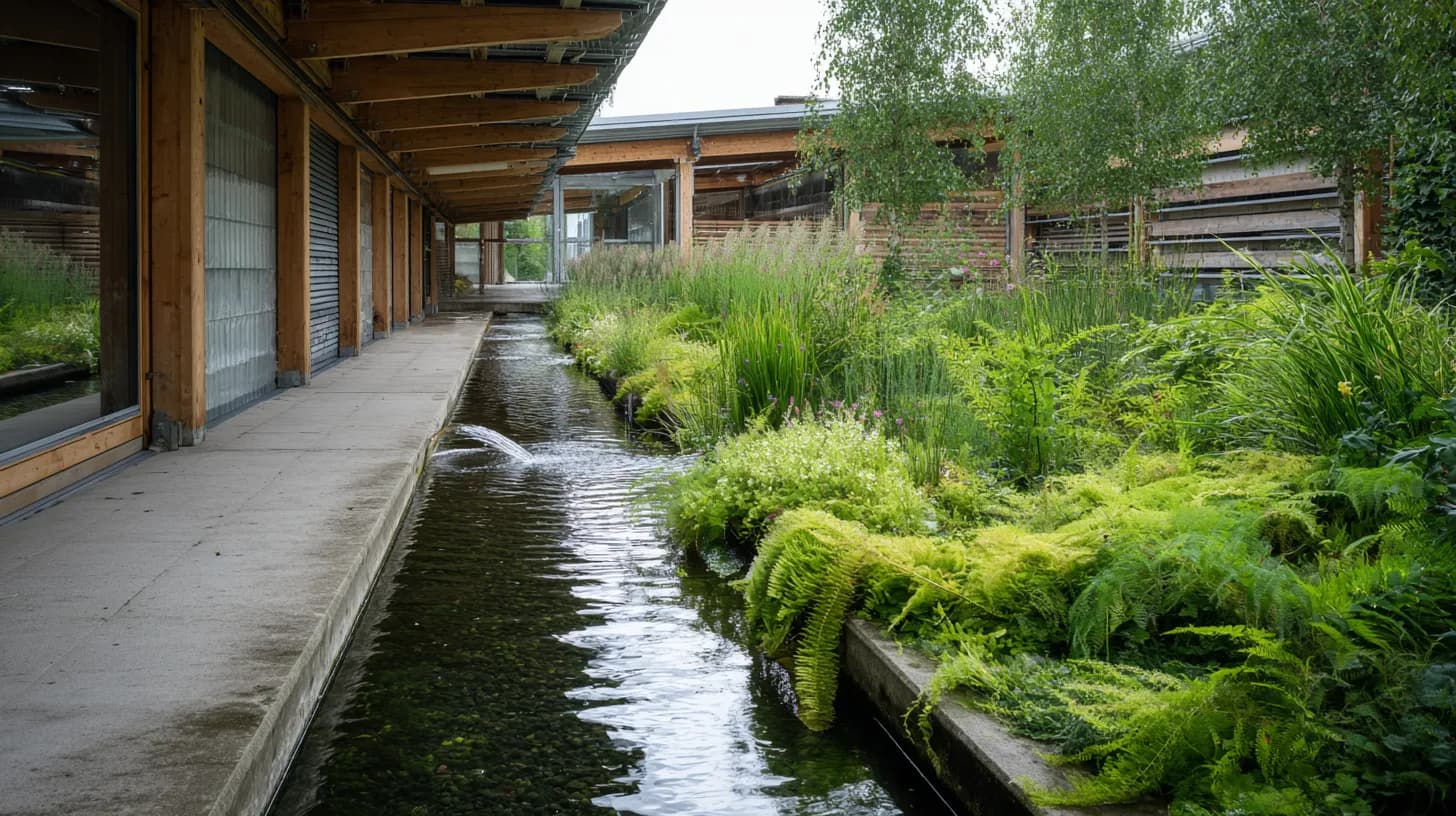
AI-generated visualisation · illustrative, not a client project
Not just reporting — sizing the measures.
A report alone does not change a single figure. We are an engineering office: if the report shows that water, wastewater or sealed surfaces are your biggest items, we plan the solution right away — rainwater harvesting, greywater recycling, nature-based wastewater treatment, unsealing and rain retention. With us, circular economy is not chapter 4 of the report; it is a site plan with sizing, signed off under professional responsibility.
Three steps to the report.
Initial consultation
30 minutes, free. We clarify: who is asking you for ESG data, which module fits, which data already exists — and whether you need a report at all.
Data collection
You receive checklists that say exactly which bill, which meter, which list is needed. Your team fills them in; we verify and calculate — including the CO₂ balance.
Report & handover
Finished VSME report with CO₂ balance and measure shortlist — usable as the answer to bank and customer requests. Annual update on request.
Frequently asked questions.
Is the VSME report mandatory?
No — the VSME is a voluntary standard. Mandatory reporting applies (as of today) to large or capital-market-oriented companies. As an SME you feel the pressure indirectly: through ESG questionnaires from banks, insurers and key accounts. The VSME report is the standardised answer — produced once, usable for all requests.
What is the difference to the CSRD?
The CSRD is the EU reporting obligation for large companies. Small and medium-sized companies without capital-market orientation are generally not directly in scope — but they receive data requests from the supply chains of obligated reporters. EFRAG developed the VSME precisely for this: a lean, voluntary standard sized for SMEs.
Which data do you need from us?
In essence: energy and water bills, fuel or fleet data, waste volumes, headcount and some information on site and processes. Our checklists guide you step by step — your team needs no prior ESG knowledge.
Can you also implement the measures?
Plan them: yes — that is our core business as an engineering office, from rainwater harvesting and greywater recycling to nature-based wastewater treatment and unsealing. Construction is done by your contractors; on request we provide tender documents so you can compare offers.
What happens after the first report?
The data structure is then in place — the annual update is considerably leaner than the first report. And once you have implemented measures, the follow-up report then shows whether and how drinking-water consumption, fees and the CO₂ balance have changed.
Free · No obligation · 30 minutes
Turn sustainability into a number.
One conversation clarifies three things: whether you need a report, which data you are still missing — and what both cost, as a fixed price, before you commit.
- Fixed price, no hidden costs
- Every figure with a source reference
- Report and measures from one office