Service · Our core competency
Constructed wetland, not a pit. A pool without chlorine.
Both are structures relevant under water law: we plan review-ready, you or your landscaper build.
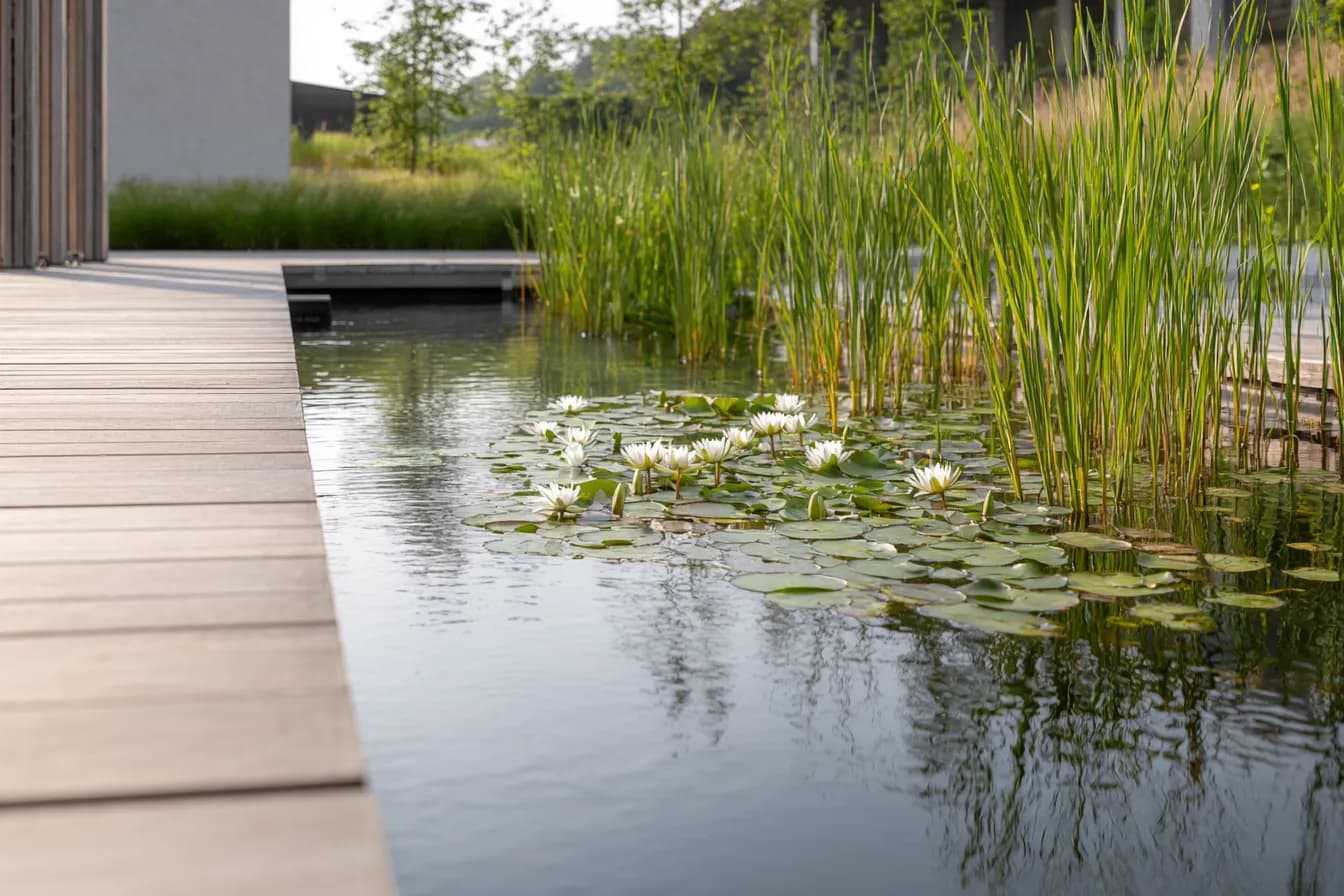
What brings you here?
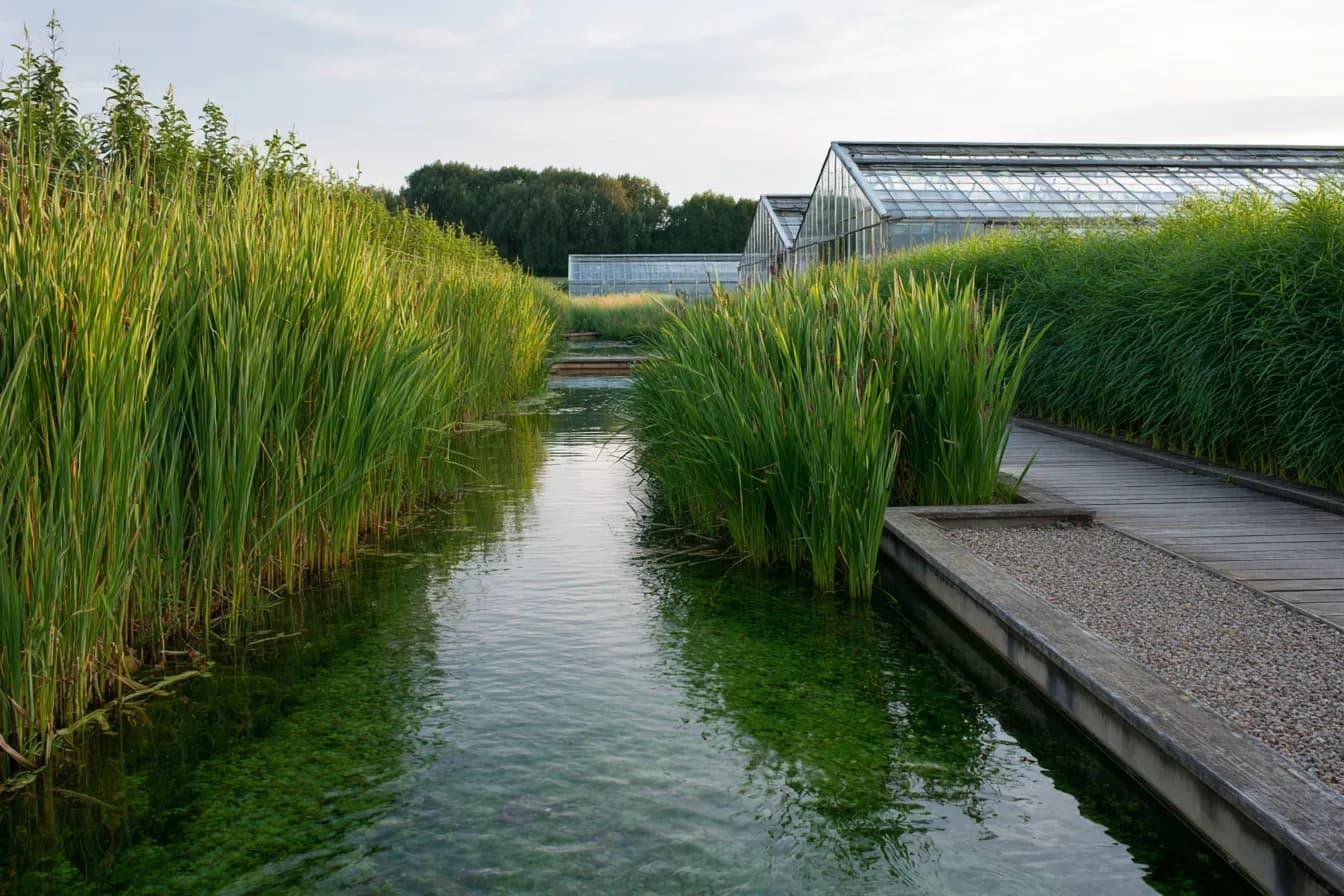
No sewer connection
A constructed wetland instead of a small treatment plant
Your property lies outside the public sewer network, and a small treatment plant is due — as a new build or as a replacement for an old pit. A constructed wetland treats the wastewater biologically, uses barely any energy and blends into the garden rather than sitting beside it. It is a structure that requires a permit: the lower water authority grants approval on the basis of review-ready planning.
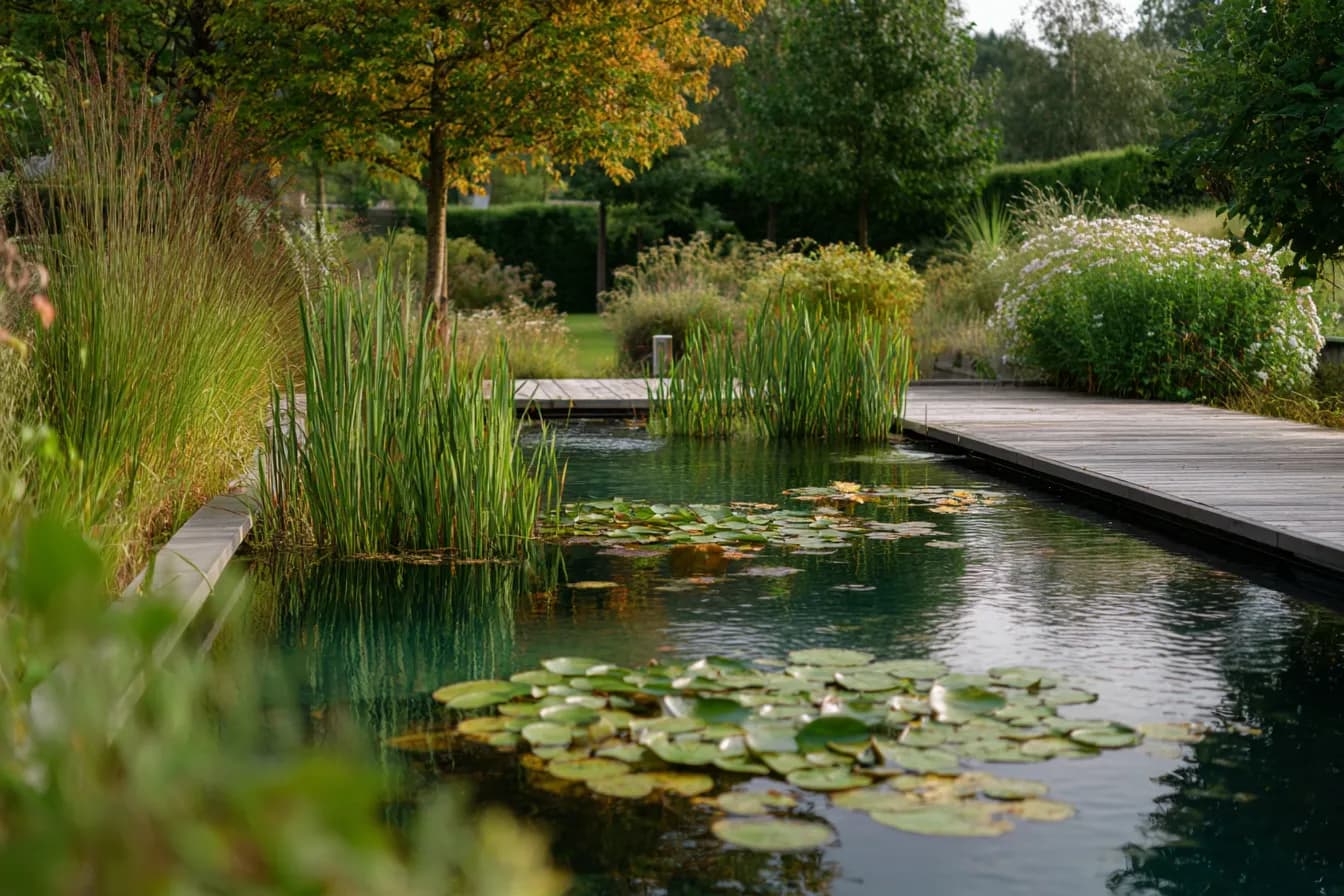
Swimming without chemicals
Swimming pond or natural pool
You want a swimming pond or natural pool: water that stays clean through planted zones and substrate filters — without chlorine, without a plant room full of chemicals. For this to work in the long term, the design is decisive: regeneration area, flow-through, sealing. And above a certain size, the authority requires a permit here too.
When the authority has a say.
Constructed wetland: always. Discharging treated wastewater is a use of a body of water that requires a permit — the lower water authority decides on the basis of the planning. The design basis is the DWA set of rules for planted soil filters (DWA-A 262).
Swimming pond / natural pool: In NRW, swimming pools up to 100 m³ in volume are generally exempt from building permit requirements (§ 62 (1) BauO NRW) — in outlying areas only as an ancillary facility of a building with habitable rooms no more than 50 m away — and "procedure-free" does not mean "rule-free": zoning plan stipulations, setback rules and water-law requirements (proximity to groundwater, water protection areas, filling and draining) still apply. From around 100 m³, or in special locations, a permit requirement should be expected. The planning basis is the FLL guidelines for swimming and bathing ponds.
As soon as a permit is involved: the authority expects a review-ready design — with traceable design parameters and sound sealing planning. A nice garden plan alone is not enough. And even for a permit-free pond, the design determines whether the water stays clear for good.
Whether your project requires a permit is something we clarify in a free initial consultation — based on your municipality and your property, in 30 minutes.
What you receive.
A complete, review-ready plan — for the authority and for the contractor who builds it:
The result: review-ready documents for the authority — and a plan designed so the system still works in its third summer.
- Dimensioning and design of the system (treatment stages or regeneration zones, areas, flow-through) — every design parameter with a source reference
- Site plans and sections (DWG + PDF), ready to build for your landscaping or civil engineering contractor
- Sealing concept in accordance with the FLL water-body sealing guideline — the point at which ponds fail in practice
- Documentation for the water-law permit, ready to submit to the lower water authority
- On request: tender documents so you can compare bids from construction contractors
AI-generated visualisation · illustrative, not a client project
Turnaround time
often 2–4 weeks from complete documentation — deadline binding in the quote
Standards
DWA-A 262 · DWA-A 222 · FLL Swimming and Bathing Ponds 2017 · FLL Water-Body Sealing
A typical case (illustrative example)
Farmstead in the outer zone, four residents, no sewer, the old septic tank needs replacing. Instead of a technical package treatment plant: a constructed wetland with at least 16 m² of filter area (at least 4 m² per population equivalent), three-chamber primary settlement, sized to DWA-A 262. The lower water authority receives a review-ready dossier; the client's landscaping firm builds to our execution plans. Running costs afterwards: hardly any electricity, maintenance under the maintenance contract.
Fixed price. You know what the planning costs before the first shovel goes in the ground.
Swimming pond / natural pool (concept) — feasibility, design of the regeneration zones, permit assessment for your property.
from €1,200 net (from €1,428 incl. VAT)Constructed wetland (planning + permit documentation) — complete dimensioning to DWA-A 262, ready to submit to the water authority.
from €1,500 net (from €1,785 incl. VAT)Swimming pond / natural pool (full planning) — complete execution planning including sealing concept and tender documents.
from €6,000 net (from €7,140 incl. VAT)Net prices plus 19% VAT; bracketed figures are gross prices incl. VAT for private clients.
A binding fixed-price quote for your property promptly after the initial consultation — or the specific question about what's still needed for it. External services (e.g. soil survey, water analyses) are itemised separately — no hidden line items. The construction costs themselves are awarded by your construction company; with our tender documents you can compare bids on an equal footing.
For perspective: the planning usually costs a few percent of your project budget — and takes care of the two points on which pond projects hinge in practice: the right application (especially in the outer zone) and a design that holds up biologically — in the second and third summer too.
What determines the price and the timeline.
So that a higher quote never looks like bait pricing, we openly name the factors that determine the effort:
- Population equivalents and effluent requirements — For constructed wetlands, the connected population equivalents and the required effluent quality determine the filter area and system type (DWA-A 262).
- Primary settlement — An existing, usable primary settlement reduces the effort — a new three-chamber tank increases it.
- Discharge or infiltration — Where the treated water goes decides the approval route: infiltration requires an additional water-law permit.
- Basin volume and location (swimming pond / natural pool) — Swimming pools up to 100 m³ of basin volume are generally exempt from a building permit (§ 62 (1) BauO NRW) — in outlying areas only as an ancillary facility of a building with habitable rooms no more than 50 m away — and water-law requirements still apply. Above that, or in special locations: an approval procedure.
- Authority fees — Fees of the lower water authority are not part of the planning fee and differ by district — we itemise them separately in the proposal.
Which of these factors apply to your project is what we clarify in the free initial consultation — after that you know price and deadline, bindingly.
What does your case cost?
Describe your project — you promptly receive a binding fixed-price quote or the specific question about what is still needed for it.
Free · No obligation
Describe your project, receive a fixed price.
You promptly receive the binding fixed-price quote — or the question about what is still needed for it.
You can submit documents by email after our reply.
Prefer to call? Call us
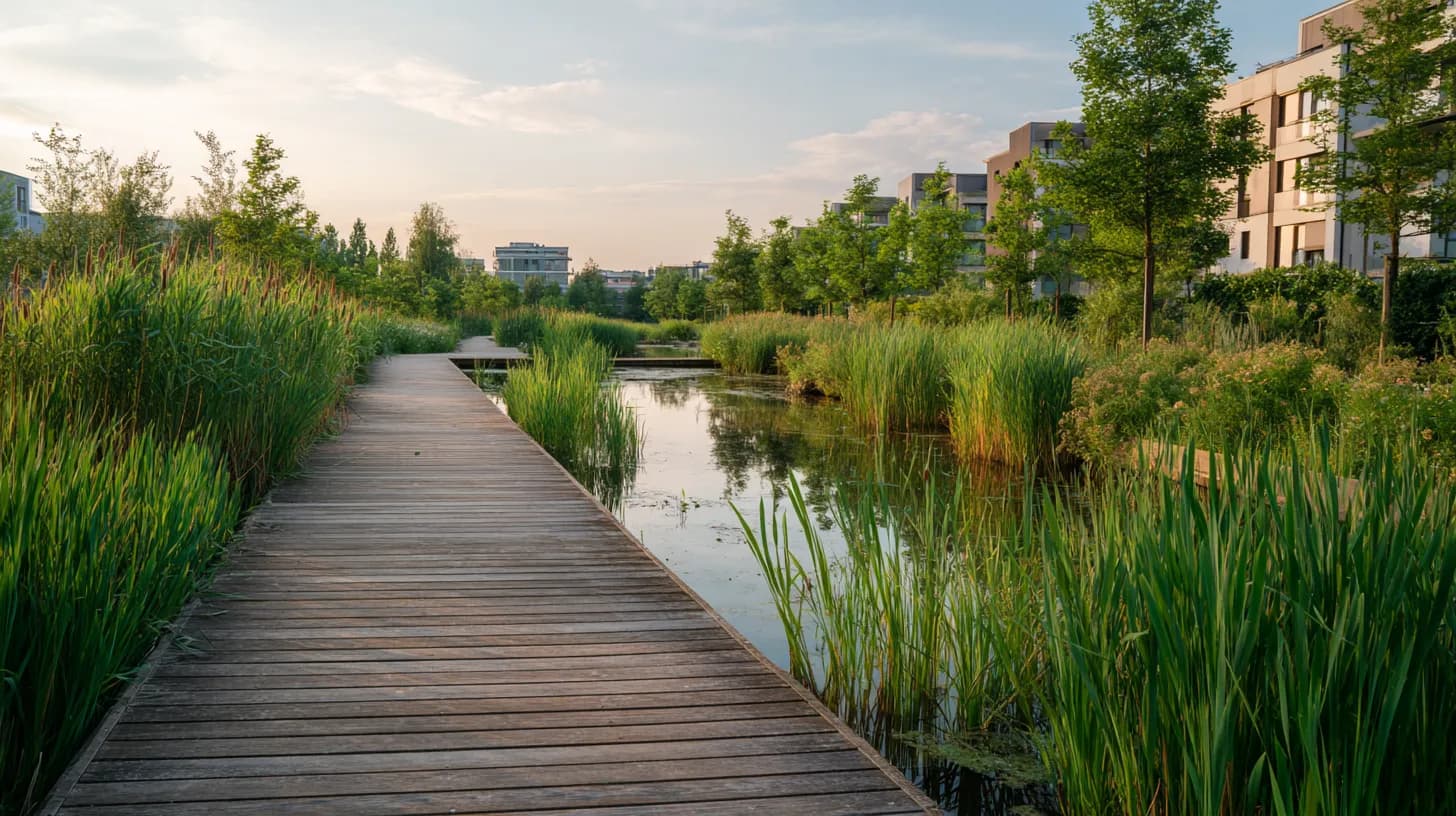
Here, biology is no side issue.
A constructed wetland and a natural pool are half biology: planting, substrate build-up, nutrient balance, start-up operation. That is exactly where our strength lies: the founder's background in bionics (M.Sc.) — the engineering discipline that learns from nature. The methods themselves are proven and standardised (DWA-A 262, FLL) — not experiments. We plan both halves: the dimensioning the authority reviews, and the biology that decides whether the system still works in its third summer.
What the system does for your property — beyond the wastewater.
Habitat instead of a plant room
A planted soil filter is a biotope: reeds, insects, birds — your treatment system becomes the greenest part of the garden.
Almost no electricity, no chemicals
Plants, substrate and microorganisms do the cleaning. With good maintenance, a service life of over 25 years is achievable — at minimal energy demand; that lowers running costs and the CO₂ footprint.
Water stays in the local cycle
Treated water infiltrates on site or feeds the pond and irrigation; evaporation cools the microclimate in summer — your property becomes a small sponge-city building block.
We stay reachable.
For small wastewater treatment systems, a maintenance contract is as a rule prescribed, a natural pool needs its biological balance — and both need someone watching in the first year. On request we take on the technical support: commissioning support in the first operating year, annual function check with a written report, accompaniment of official sampling, a direct line when something looks off. Annual flat fee by system size — stated in the proposal before you commission.
You build. We sign off under professional responsibility.
Your client wants the pond from you — but the authority wants a review-ready plan. That is exactly the division of labour we offer: you keep the client relationship and the construction contract, we deliver the dimensioning, sealing concept and permit documentation. We remain available for questions throughout construction, so that nothing is lost between plan and execution.
Discuss working togetherThree steps to submission.
Initial consultation
30 minutes by video call, free of charge. We clarify: property, municipality, permit requirement — and whether a constructed wetland or a natural pool makes technical sense for you.
Fixed-price quote
in writing promptly: service, deliverables, turnaround time from complete documentation, one figure — or the specific question about what's still needed for it.
Planning & handover
review-ready documentation, professionally signed off: for the authority to review, for your contractor to build. On request, we continue to support the process — responding to queries, filing supplementary documents, coordinating the required investigations (on a time-and-effort basis).
Frequently asked questions.
Does a constructed wetland also work in winter?
Yes. Planted soil filters treat wastewater year-round — the relevant processes take place in the substrate, not in the above-ground parts of the plants. Dimensioning to the DWA set of rules accounts for winter operation; what matters is the correct sizing of the filter areas, not the season.
How much space does a constructed wetland need?
That depends on the number of connected residents and the system type chosen — as a guide: for a single household the area required is typically in the order of a few square metres per resident. The exact area follows from the dimensioning; whether your property is large enough is something we clarify in the initial consultation.
Is a natural pool really clean without chemicals?
Yes — provided the design is right. The cleaning is carried out by regeneration zones with plants and substrate filters; the ratio of swimming to regeneration area, the flow-through and the sealing determine the water quality. That very design is our planning service in accordance with the FLL guidelines.
Do I really need a permit for a swimming pond?
Not always — but the answer has conditions: in NRW, swimming pools up to 100 m³ in volume are generally exempt from building permits (§ 62 (1) BauO NRW) — in outlying areas only as an ancillary facility of a building with habitable rooms no more than 50 m away. "Procedure-free" also doesn't mean "rule-free": zoning plan stipulations, setback requirements and water-law requirements (e.g. proximity to groundwater, water protection areas, or filling and draining) still apply. From around 100 m³, or in such special locations, a permit requirement should be expected. We clarify what applies to your specific property in the free initial consultation — before you plan or build anything.
Can my landscaping contractor build the system?
Yes — that is the intended model. We deliver the review-ready plan with site plans, sections and sealing concept; any qualified landscaping or civil engineering contractor can build from it. On request, we prepare tender documents that let you compare bids from several contractors on an equal footing.
What if the authority has queries or requires additional investigations?
This happens and is no cause for alarm: depending on the location, the water authority may require, for example, a soil investigation, details of the groundwater level, or water analyses — for constructed wetlands, also requirements for effluent monitoring. We tell you as early as the initial consultation what is typically to be expected at your location, formulate the responses to queries and, on request, coordinate the necessary investigations with suitable experts and laboratories — as a separately itemised line. That keeps your process moving.
Who signs off on the planning?
Alvaro Burgos Cifuentes, M.Sc., registered member of the Ingenieurkammer-Bau NRW (No. 754661), with professional liability insurance for the planning service. Insurance details: see the About page and the legal notice. All dimensioning and plans are personally reviewed, signed and stamped with the member's stamp of the Ingenieurkammer-Bau NRW.
I am buying a house with a small wastewater treatment system — can you check it before purchase?
Yes — that is exactly what the pre-purchase system check is for: we assess the technical condition, sizing and foreseeable costs of the existing system (package plant, constructed wetland or cesspit) and summarise the result in a written memo — before you sign. A leak test or legal assessment is not included. The unknown in the purchase contract becomes a calculable item.
Free · No obligation · 30 minutes
Is this a fit for your property?
One conversation answers the three decisive questions: Does your project require a permit? Does it make technical sense on your property? And what does the planning cost — as a fixed price, before you commit.
- Fixed price, no hidden costs
- Professionally signed off, insured planning service
- Planning for the authority and biology for the third summer