Service · Use water twice
Use rainwater — with numbers that add up beforehand.
Rainwater and greywater, planned to DIN and DWA — with a cost-effectiveness analysis from your figures.
Alvaro Burgos Cifuentes, M.Sc. · Ingenieurkammer-Bau NRW No. 754661 · Insured engineering service · Fixed price
What brings you here?
Harvest rainwater
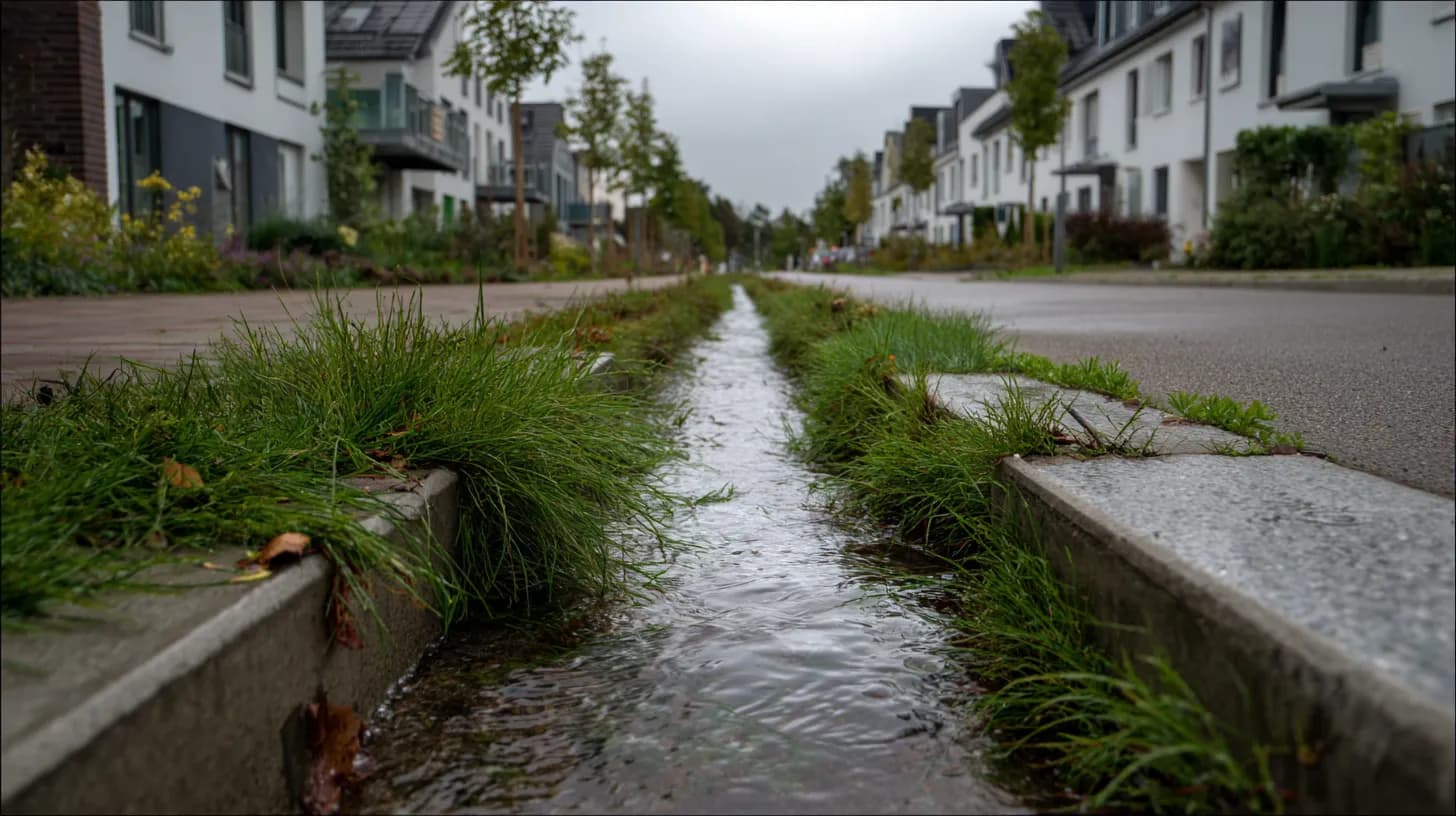
Every year your roof collects many cubic metres of water that currently run into the sewer — while you pay for drinking water for the garden, WC flushing and washing machine. A rainwater harvesting system (cistern, filter, top-up supply, separate pipe network) replaces part of that. Done right means: a correctly sized cistern, standard-compliant separation from the drinking-water network and a system matched to your actual consumption — not to the manufacturer's catalogue.
Recycle greywater
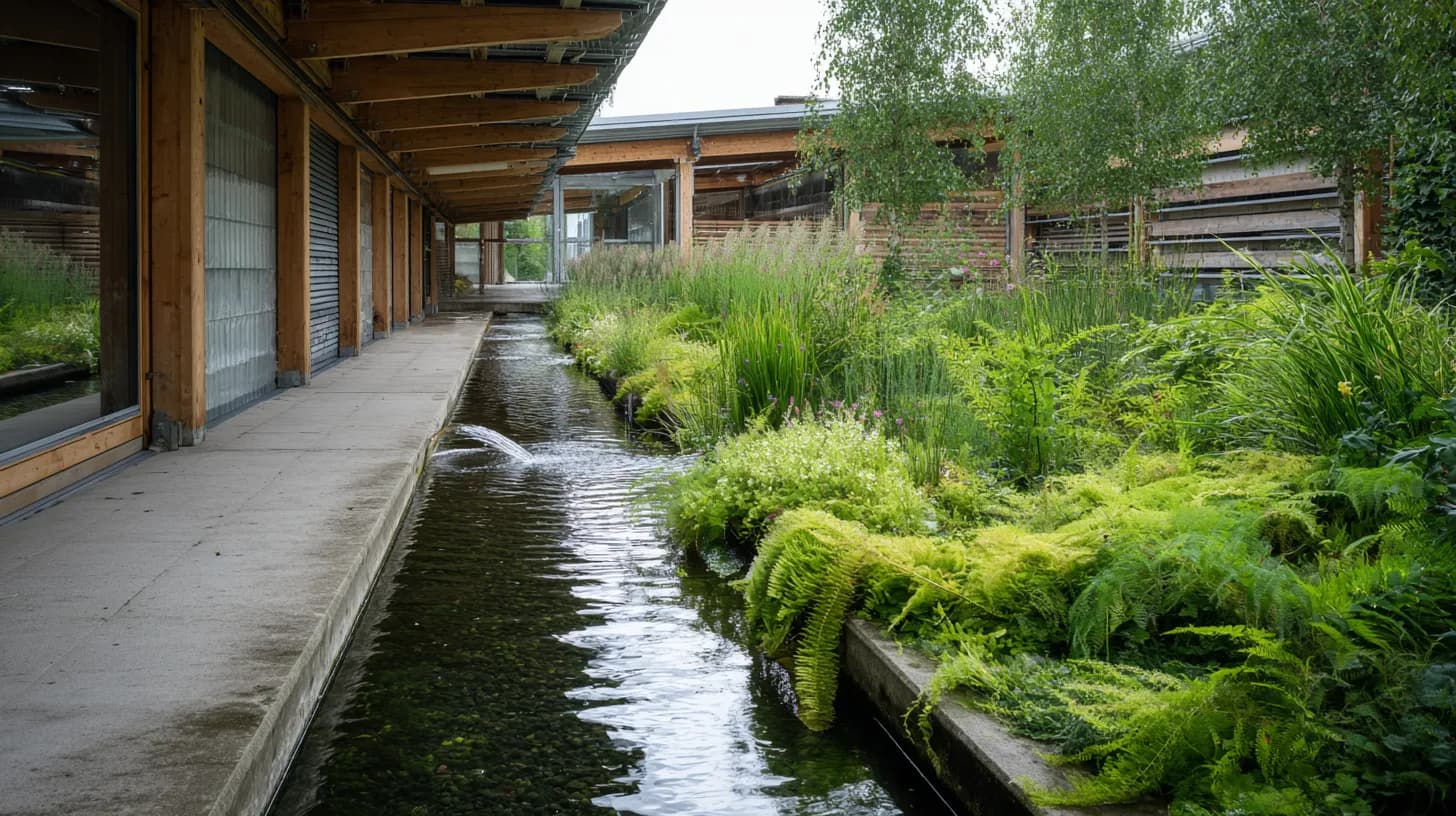
Shower and bath water is too good for the sewer: once treated, it replaces drinking water for WC flushing and irrigation — of particular interest for apartment buildings, hotels and commercial properties with high, steady water consumption. The design (volume produced, storage, treatment stage) determines whether the system runs economically or is merely well-intentioned.
Before you buy
Three things that should be settled before you buy.
The system is subject to mandatory notification.
In-building rainwater and greywater use must be notified to the water utility and the public health authority; the service-water network must be securely separated from the drinking-water network (DIN 1989-1). Our plan provides the documentation for this — cleanly documented rather than argued out after the fact.
The cistern size is a calculation, not a gut feeling.
Too small forfeits yield, too large wastes money and lets the water go stale. Sizing to DIN 1989 works from your roof area, the local rainfall and your consumption profile.
Cost-effectiveness is a property of the building, not of the technology.
The same system pays off in an apartment building but not in a weekend cottage. That is why we calculate first — investment, operation, drinking water replaced, payback based on your water and wastewater prices — and only then make a recommendation. Even if the answer is: not worth it here.
What rainwater costs you today — without you using it.
In NRW, property owners pay, at a population-weighted mean, around €1.13 per m² of sealed surface per year for stormwater via the split wastewater charge (LANUV NRW, status report 2022; median €0.83/m²) — year after year. For a single-family home that's typically under €200 a year: real, but no savings miracle — and we say so openly. The lever grows with the surface: a 5,000 m² commercial roof represents around €5,650 in stormwater charges per year at the NRW average. Those who infiltrate or use rainwater instead of discharging it can reduce this charge or — depending on the municipal statute and on application — eliminate it entirely; many NRW municipalities additionally subsidise cisterns. What applies at your location — rate, discounts, subsidies — is what we clarify in the initial consultation.
What you receive.
The result: you invest on the basis of an open calculation — not a brochure.
- Cost-effectiveness analysis for your building: investment, operating costs, drinking water replaced, payback calculation based on your local water and wastewater prices — every assumption disclosed
- Sizing and design of the system: cistern or storage size, filter, top-up supply, and for greywater the treatment stage — every design figure with a source reference
- Drawings and schematics (PDF, DWG on request) for your installation or construction contractor
- Documentation for notification and record-keeping vis-à-vis the water utility and public health authority
- Manufacturer-neutral recommendation — we do not sell systems and receive no commission; we recommend what fits the building and the budget
AI-generated visualisation · illustrative, not a client project
Processing time
often 1–2 weeks from receipt of complete documents — deadline binding in the quote
Standards
Fixed price. The calculation first, the investment second.
Cost-effectiveness check — does rainwater or greywater use pay off for your building? A calculation based on your figures, a written result, a clear recommendation — even if it is “no”.
Rainwater harvesting (planning) — sizing to DIN 1989, filtering and network separation, notification documents, cost-effectiveness analysis included.
Greywater system (design) — determination of volume produced and demand, treatment and storage to DWA-M 277, for apartment buildings and commercial properties.
Net prices plus 19% VAT; bracketed figures are gross prices incl. VAT for private clients.
Binding fixed-price quote for your building promptly after the initial consultation — or the specific question about what's still needed for it. The cost-effectiveness check is credited against a subsequent planning commission.
What determines the price and the timeline.
So that a higher quote never looks like bait pricing, we openly name the factors that determine the effort:
- Notification duty — A non-potable water system in the building must be notified to the health authority at least four weeks before installation (Section 12 TrinkwV) and to the water utility under § 3 (2) AVBWasserV. Our planning includes the documents for this.
- Network separation to DIN 1989-1 — Rain and greywater are fluid category 5 — only a free outlet (type AA/AB) is permissible. This separation must be planned and documented.
- Building type — Single-family home, apartment building or commercial: yield, storage and treatment scale — greywater recycling generally only pays off from apartment-building, hotel or commercial scale.
- Split wastewater charge — Whether and how your municipality credits infiltration or use against the stormwater charge differs locally — we check it as part of the planning.
Which of these factors apply to your building is what we clarify in the free initial consultation — after that you know price and deadline, bindingly.
A typical case (illustrative example)
Family with a new build, 160 m² of roof area, a garden, two bathrooms. The calculation with local water and wastewater prices shows: a cistern for WC flushing, washing machine and garden replaces a relevant share of drinking water — and the municipality subsidises the installation. Result of the cost-effectiveness check: a clear recommendation with an amortisation period, every assumption disclosed. Had the result been “not worth it”, that's exactly what we would have written.
What does your case cost?
Describe your project — you promptly receive a binding fixed-price quote or the specific question about what is still needed for it.
Free · No obligation
Describe your project, receive a fixed price.
You promptly receive the binding fixed-price quote — or the question about what is still needed for it.
You can submit documents by email after our reply.
Prefer to call? Call us
We sell the planning — not the system.
We do not sell systems — our sizing has no sales interest. We are an engineering firm, not a sales agency: our recommendation follows from the calculation, and we lay that calculation open — every assumption, every price, every source. Together with infiltration and near-natural systems, we plan a property's water as a whole: what is not used is infiltrated; what accumulates is managed rather than discharged.
Infiltrate rainwater instead of using it? To the infiltration verification
Three steps to a decision.
Initial consultation
30 minutes by video call, free of charge. We clarify: building, consumption, roof area — and whether a cost-effectiveness check or going straight to planning makes sense.
Fixed-price quote
In writing promptly: service, deliverables, processing time from receipt of complete documents, one figure — or the specific question about what's still needed for it.
Calculation & planning
First the cost-effectiveness with your figures, then the design. You decide on the basis of an open calculation — not on the basis of a brochure.
Frequently asked questions.
Does a rainwater harvesting system pay off financially?
That depends on the building — on roof area, number of occupants or consumption profile, and the local water and wastewater prices. Blanket savings promises are not serious; that is precisely why the cost-effectiveness analysis based on your figures is part of every plan. You see investment, operation and payback before you invest — and if it does not pay off, we say so.
May I use rainwater for the WC and washing machine?
Yes — service water may be used for WC flushing, the washing machine and irrigation. The requirement: a pipe network securely separated from the drinking-water network (DIN 1989-1), labelled draw-off points and notification to the water utility and public health authority. Our plan provides this documentation.
Who does greywater recycling pay off for?
Above all where a lot of water accumulates and is used steadily: apartment buildings, hotels, sports facilities, commercial properties. In a detached house the simpler rainwater harvesting is usually the more economical route — the cost-effectiveness check shows that too, before you commit.
Do you also sell the system?
No — deliberately not. We plan on a manufacturer-neutral basis and receive no commissions. You receive a design with which you can compare quotes from installation and construction contractors on an equal footing.
What if the water utility or public health authority has queries?
That too is a normal part of the process: possible items include, for example, proof of network separation, labelling of draw-off points or, for greywater systems, water-quality requirements. Our plan provides the documentation for this from the outset; should queries nonetheless arise, we formulate the responses and, on request, coordinate any required analyses. That way commissioning does not get stuck on formalities.
Who signs off on the planning under professional responsibility?
Alvaro Burgos Cifuentes, M.Sc., registered member of the Ingenieurkammer-Bau NRW (No. 754661), with professional liability insurance for the engineering service. Insurance details: see the About page and the legal notice. All calculations and drawings are personally reviewed, signed and stamped with the member's stamp of the Ingenieurkammer-Bau NRW.
Free · No obligation · 30 minutes
Does it pay off for you?
One conversation, three answers: what makes technical sense for your building? What does the planning cost — as a fixed price? And from when does the system pay for itself — calculated with your figures, not with brochure values.
- Fixed price, no hidden costs
- Manufacturer-neutral — we sell planning, not systems
- Signed off under professional responsibility, insured engineering service