Background · Law & Market
The sponge city in NRW: what actually applies — and what just sounds good.
Codes of practice, state law, EU directive: we soberly explain what is binding for whom. Without panic.
The principle in three sentences.
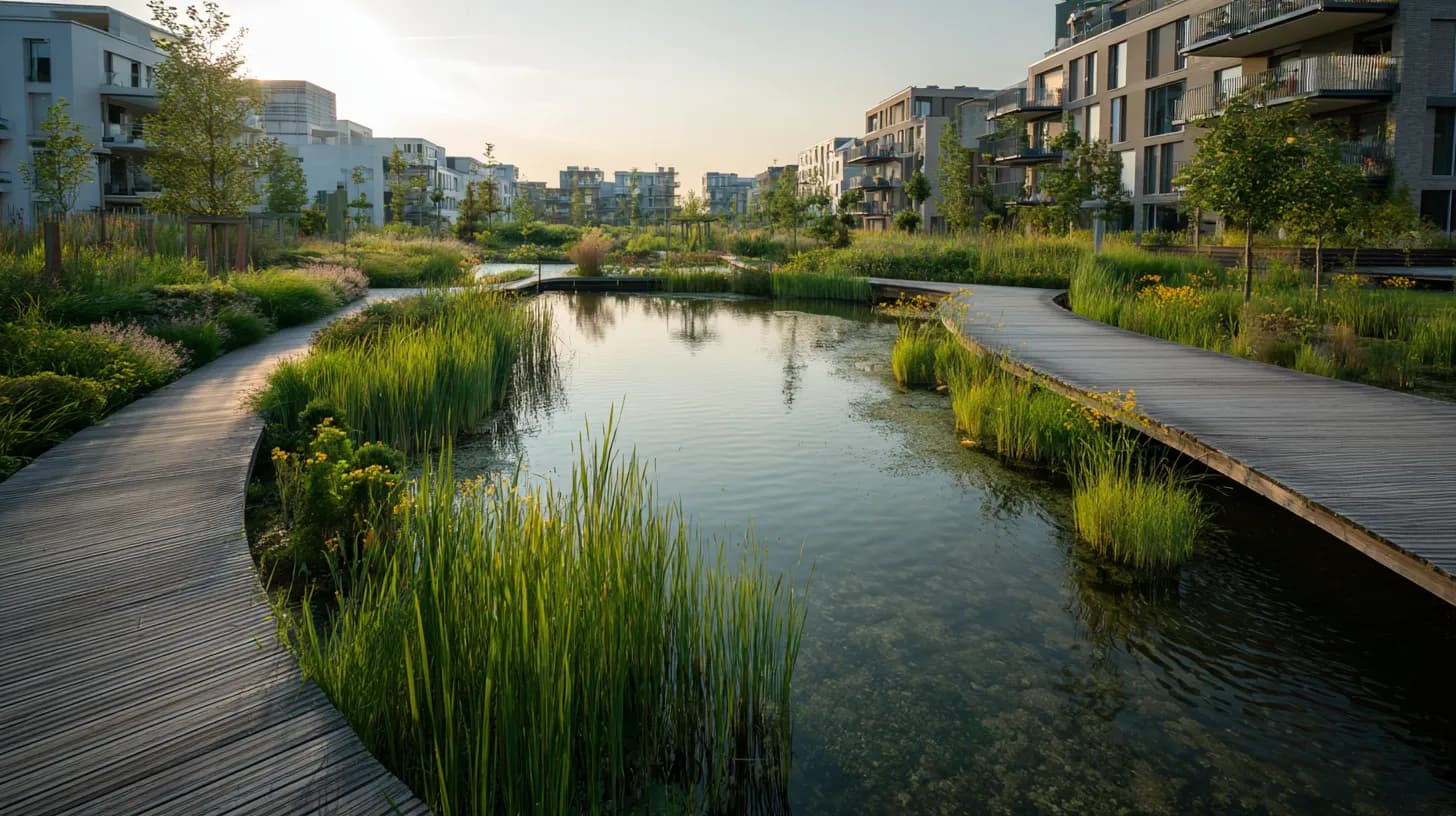
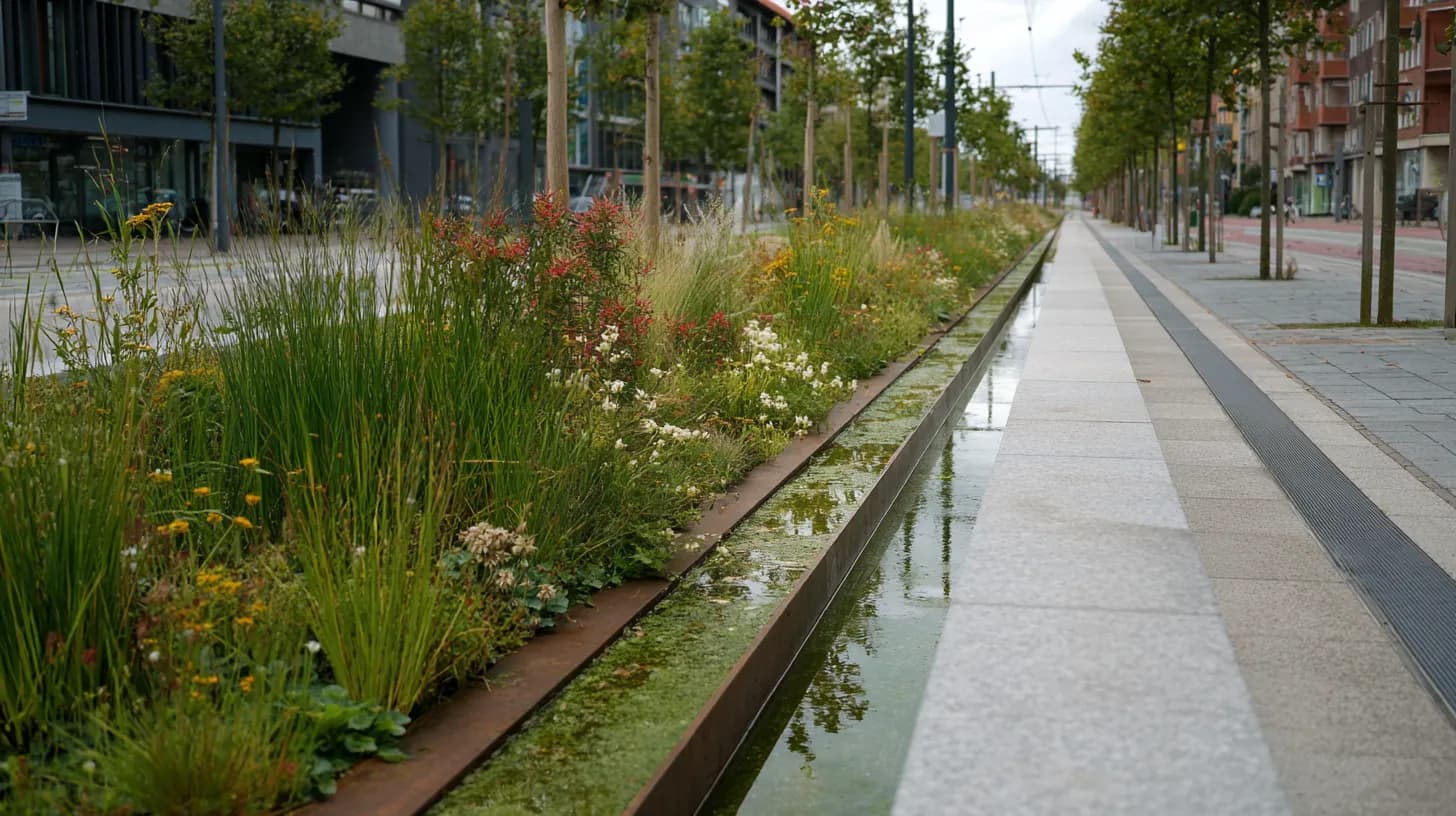
A sponge city treats rainwater as a resource rather than waste: it is infiltrated, stored, evaporated or used where it falls — instead of being channelled into the sewer as quickly as possible. The tools for this are unspectacular and proven: infiltration swales and soakaways, retention areas, green roofs, cisterns, de-sealed surfaces, near-natural water systems. What is new is not the technology — what is new is that it is shifting from a special request to the planning norm: during heavy rainfall it relieves the sewer system, and during drought it keeps water in the landscape.
The legal situation, soberly
Three levels, one trend — read precisely.
Federal law · § 55 (2) WHG
Local disposal as a target principle
Precipitation water should be infiltrated, allowed to percolate or discharged locally, provided that neither water-law nor other public-law provisions nor water-management interests stand in the way. Important for an honest reading: this is a target principle subject to weighing of interests — not a rigid obligation with a date. But it is the direction in which every authority decides.
State law NRW · § 44 LWG NRW
Proof on the property
NRW makes the federal principle concrete: stormwater from properties first built on, paved or connected to the public sewer after 1 January 1996 is to be disposed of in accordance with § 55 (2) WHG — infiltrated, allowed to seep away or discharged into a body of water close to where it falls, unless provisions or water-management concerns stand in the way. In permitting practice this means: anyone who newly seals surfaces must show how the water is managed on the property — infiltration is in many cases a use of a body of water requiring a permit, which the water authority decides on based on verifiable planning.
EU level · Directive (EU) 2024/3019
The Urban Wastewater Directive, correctly understood
Recast Urban Wastewater Treatment Directive: threshold lowered to 1,000 PE, a quaternary treatment stage for large plants, energy neutrality for municipal treatment plants of 10,000 PE and above by 2045; the deadline for transposition into national law is 31 July 2027. To put this in context: the deadline first binds the legislator, not the individual construction project — it shows the direction in which national law and municipal by-laws are developing.
Practice, not forecast
Not at some point — already everyday permitting practice.
- Water authorities are demanding proof more consistently: Only 9.4% of NRW's watercourses currently reach the required good ecological status (NRW environmental indicators, LANUK, 2018–2021 survey). This pressure to act translates directly into practice — for newly sealed surfaces, proof of infiltration is routinely required.
- Municipal by-laws are following suit: split wastewater charges, infiltration requirements in development plans, de-sealing programmes — going to different lengths depending on the municipality. Only around 100 of the 396 NRW municipalities have a climate adaptation concept today (LANUK climate atlas, as of 2025); the draft amendment to the NRW Climate Adaptation Act (Drs. 18/18827, introduced April 2026, adoption announced for autumn 2026) is to make such concepts binding for all municipalities by ordinance — targeted by the end of 2029.
- Market and funding are growing: In NRW alone, just under 10,000 implementation measures are planned in the 2022–2027 river basin management plan, with a volume of around €3.7 billion (MUNV NRW).
- Planning capacity is the bottleneck: The industry survey by AHO/BAK/VBI/BIngK (IW, 2025, 2,452 firms) describes skills shortages and growing workloads increasingly limiting offices' capacity — the honest consequence for project owners: the risk is not the deadline, but the queue.
Sources
- River basin management plan 2022–2027 — MUNV NRW
- Climate atlas NRW — municipal climate adaptation concepts (as of 2025) — LANUK NRW
- NRW environmental indicators — ecological status of rivers (as of 2024) — LANUK NRW
- Planning offices industry survey 2025 — AHO/BAK/VBI/BIngK · IW
Three perspectives, three consequences.
For municipalities
The sponge city is both a statutory obligation and an opportunity: climate adaptation, flood prevention, fairness in charges. What counts are verifiable concepts and calculations in accordance with the DWA rules — every figure with a source reference, every assumption traceable. We support you with infiltration and water concepts for municipal areas, directly and with short distances from the region.
Discuss your project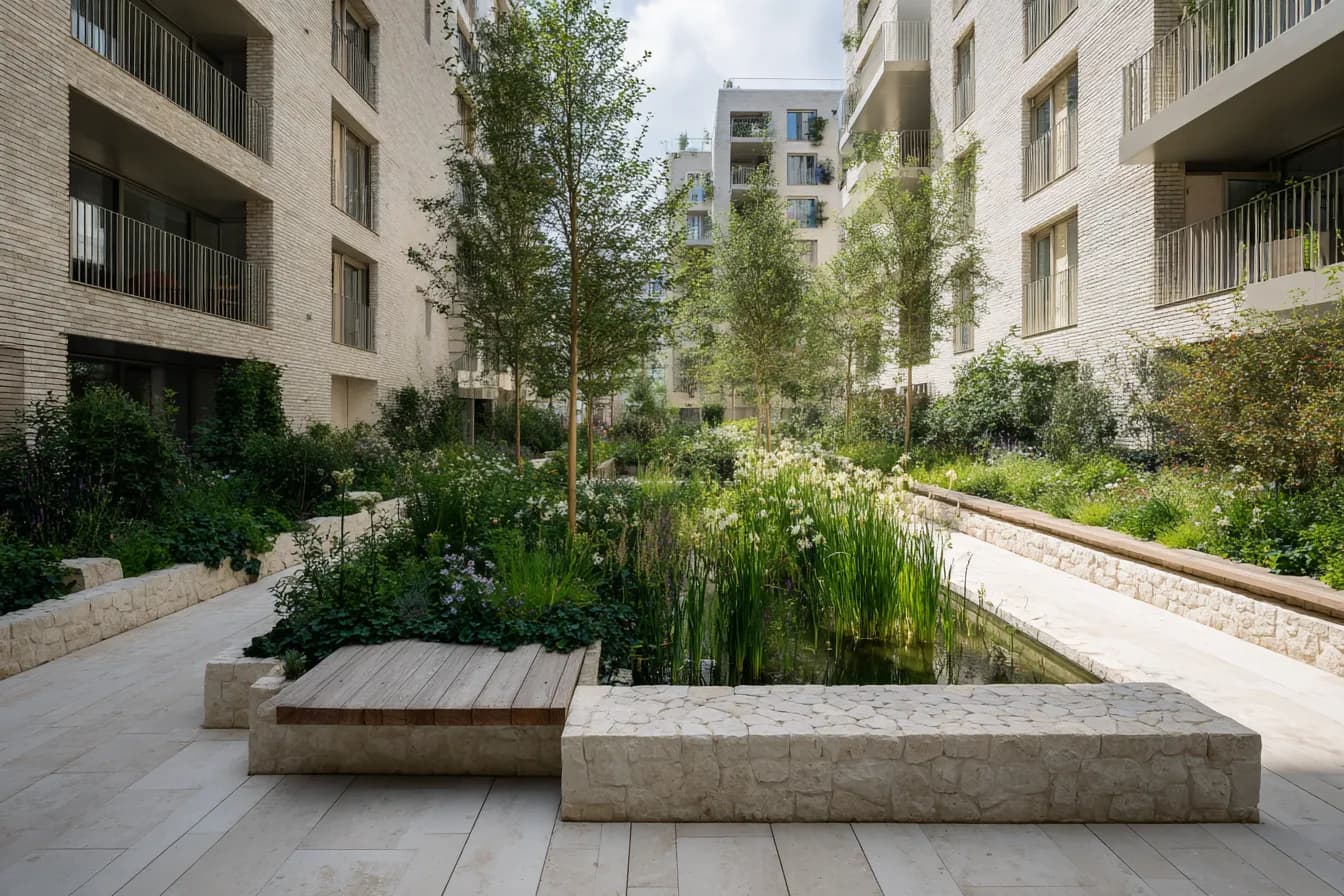
For architecture and planning offices
The water-law component is becoming the critical path in more and more projects. Whoever covers it reliably — themselves or through a partner — delivers building applications that pass the water-law review, as far as possible, without avoidable follow-up requests. That is exactly what our architect model is for: on a per-project basis or on retainer, visible or under your name.
To the architect model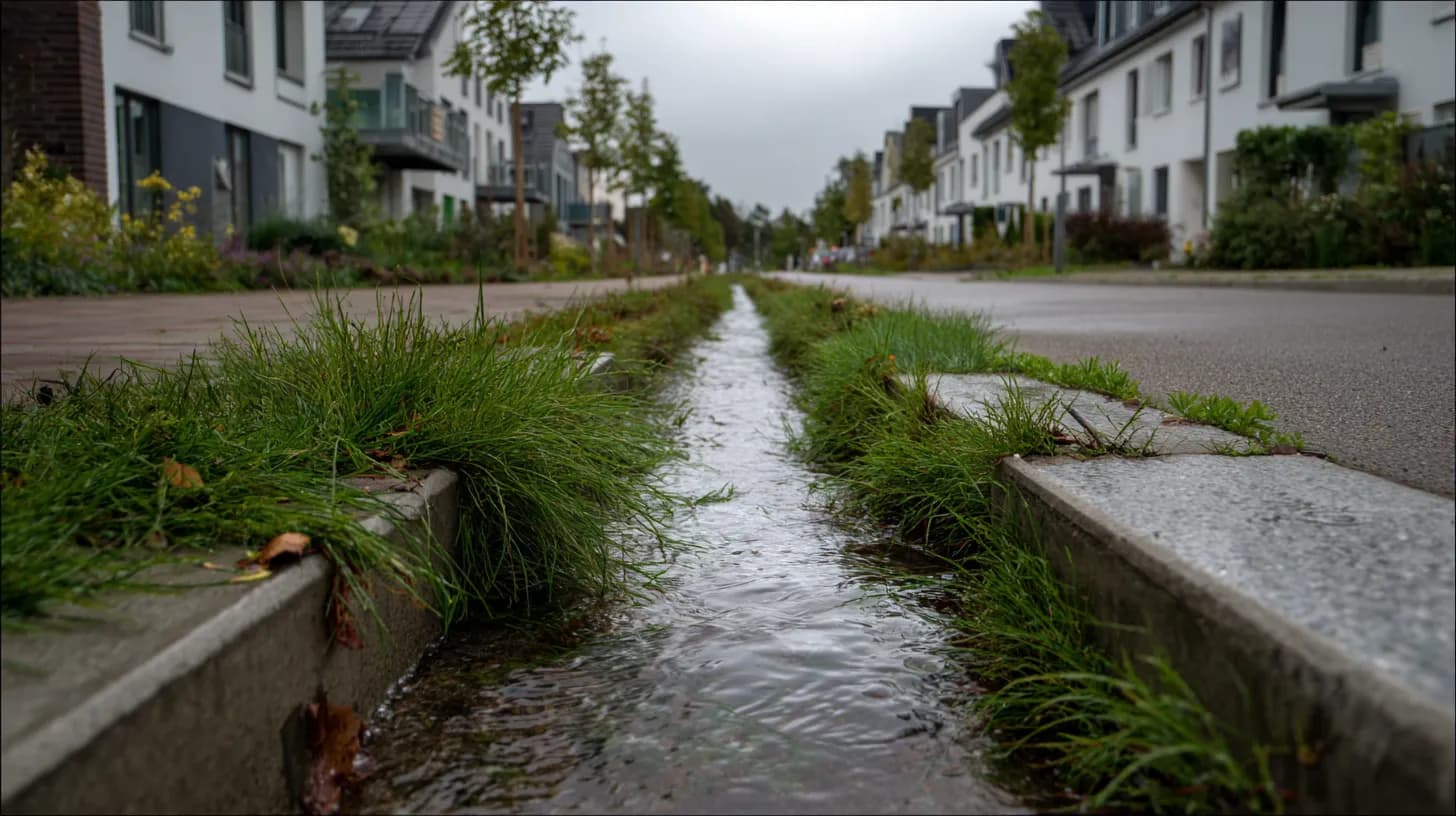
For property owners
For you, the sponge city is not a concept but a concrete requirement in the building application: proof of infiltration. And often an opportunity: if you are building anyway, a cistern, swale or near-natural system is cheapest when planned in from the start.
To proof of infiltrationWe are the planning side of the sponge city.
EKOWAI plans the building blocks that make up the sponge city on the ground: infiltration systems and their verifications, rainwater harvesting, near-natural water systems — in accordance with the DWA rules, signed off under professional responsibility, at a fixed price. The perspective on this page is the same one we apply in planning: first read the legal situation precisely, then size the design.
Frequently asked questions about the legal situation.
Is rainwater infiltration mandatory in NRW?
It is the statutory standard case, subject to weighing of interests: under § 55 (2) WHG and § 44 LWG NRW, stormwater from properties first built on, paved or connected to the public sewer after 1 January 1996 is to be infiltrated, allowed to seep away or discharged into a body of water close to where it falls, unless provisions or water-management concerns stand in the way. Whether and how this applies to a specific property is decided by the water authority — on the basis of verifiable proof. In practice, the authorities routinely require this proof for newly sealed surfaces.
Does the EU 2027 deadline apply to my construction project?
No — the transposition deadline of the Urban Wastewater Directive binds the legislator, who must transpose it into national law, not the individual project. For your construction project, today's water law applies — and that already requires local management now. The EU directive shows that this direction is more likely to be tightened than relaxed.
So why act now at all?
For two sober reasons: first, the proof requirement for newly sealed surfaces already applies today — it is not a future issue. Second, skills shortages and growing workloads are limiting planning offices' capacity (planning-sector survey 2025, AHO/BAK/VBI/BIngK · IW); anyone who needs planning is competing for processing time, not for legal clarity. That is the honest reason for commissioning early — a countdown it is not.
What is a split wastewater charge?
Many NRW municipalities calculate the precipitation water charge based on sealed area, separately from the wastewater charge. Anyone who de-seals surfaces, infiltrates or retains rainwater can reduce the chargeable area — the details are governed by the respective municipal by-law; we check this as part of the planning.
Free · No obligation · 30 minutes
What does this mean for your project?
The general legal situation is one thing — your property, your municipality, your authority is another. In an initial conversation we translate the framework into your specific situation: what is required, what makes sense, and what the planning costs as a fixed price.
- Sober assessment instead of selling deadlines
- Verifiable planning in accordance with the DWA rules
- Signed off under professional responsibility, fixed price